U.S. barley industry launches project to baseline production impact
The American Malting Barley Association (AMBA) Sustainability Committee has officially launched their Baselining Barley project, which is the first industry-wide collaborative effort to articulate the environmental impact of barley production. As a result of this work, a data monitoring tool will be developed to track continuous improvement throughout the industry. The need for such an effort has been a leading priority for many AMBA member companies who are seeking to achieve various sustainability related goals. This work complements other efforts of the committee, which is also exploring alternative nitrogen sources and strategies and exploring ways to better communicate sustainable attributes of barley varieties.
Led by Neil Fuller from the Atlas consulting firm, the Baselining Barley project will leverage real-world production data from farms that contract production acreage for AMBA members. This strategy will ensure that the calculations on metrics, including greenhouse gas (GHG) emissions, are sound and rooted in what’s actually happening in the field. “Getting data direct from farms is essential as it allows the project to showcase the incredible job U.S. barley farmers are doing, not only in producing top-quality grain, but in delivering a stack of environmental benefits that accompany that grain from soil to glass,” Fuller shared. An experienced practitioner conducting similar work with barley throughout Europe, and several other field crops in the U.S., Neil builds upon the Cool Farms Tool model to not only calculate emissions, but to also propose opportunities for emission reductions. Additional data will be collected to address other important environmental factors, including soil health, water quality, and biodiversity. “Every farming activity that goes into growing barley, from tillage and planting to fertilizing and harvesting, can generate environmental impact.” Fuller shared. “This project turns actual field records into a series of numbers that can measure, monitor and manage that impact. Those numbers feed into action plans that integrate best farm practice with the regenerative agriculture goals and sustainability ambitions of AMBA members.”
AMBA members that are purchasers of malted barley, primarily distillers and craft brewers, identified the need for this work as their companies seek to better account for upstream, also known as Scope 3 emissions, in their products, whether to meet internal sustainability goals or external reporting requirements. The industry is heavily reliant on models that use very little primary data and operate mainly on assumptions. The Baselining Barley project allows the malting barley community to groundtruth the narrative around the environmental impact of barley production. The co-chairs of the AMBA Sustainability Committee have been leading advocates of this work.
“Our premium spirits rely on the sustainability and health of our natural resources, including the agricultural ingredients like grains used to produce our bourbons. Partnering with AMBA to create a roadmap for improving sustainable production practices will lay the groundwork for industry-wide collaborations throughout the supply chain. This teamwork will help us collectively reduce our environmental carbon footprint and make a meaningful impact.”
--Kyle Day, Senior Manager of Forest and Fields at Suntory Global Spirits
“Mitigating our businesses’ contribution to a changing climate calls for close collaboration with experts across our value chain. Leveraging that expertise requires a shared understanding and a common language for the work ahead. The project AMBA is leading will provide just that, a clear, empirical understanding of where we are today, where our greatest opportunities exist, and a shared calculus for understanding the implications of different solutions.”
--Walker Modic, Environmental Programs Director, New Belgium-Bell’s Brewing
In addition to meeting the needs of domestic partners, Ashley McFarland AMBA vice president and Sustainability Committee staff lead, believes this work to be important to keep export opportunities alive as well. “The malting, brewing, and distilling industries are global businesses, and in order for U.S. barley to stay competitive, we must be able to articulate production metrics, including emissions as a result of crop production. Without this knowledge, and the ability to monitor and show the tremendous gains accomplished by the industry, our barley and barley malt will be passed over.” McFarland also noted, “although AMBA focuses on securing a domestic supply of barley for their industry end-users, we believe a healthy export market plays a critical role in ensuring that supply.”
AMBA members participating in the data collection for the project are maltsters and malster-brewers that contract barley acreage in the U.S. Each company has been asked to submit data from at least five farms that are representative of their barley production supply to assist in the calibration of the model and to establish a baseline of barley production. The 2024 crop season is the targeted dataset for this initial pilot, but the goal is to develop a model that can be used by each participating company to monitor progress in subsequent years. AMBA applauds the work by their participating members that see the value in this collaborative effort, and is grateful to the farmers that are taking the time to provide the information from their operations to ensure the work is accurate and reflective of our industry. The National Barley Growers Association (NBGA) and their membership, are critical partners in this work. “NBGA appreciates the efforts by AMBA and industry partners to prepare U.S. barley for potential marketing needs or evolving sustainability considerations. The Baselining Barley project is an important step in helping growers understand the types of data that may be relevant in future barley and barley product markets. We encourage barley growers to participate in this pilot and share their feedback to ensure on-the-ground perspectives are reflected. NBGA supports any efforts that could help to preserve, promote, and expand market opportunities for U.S. barley.”
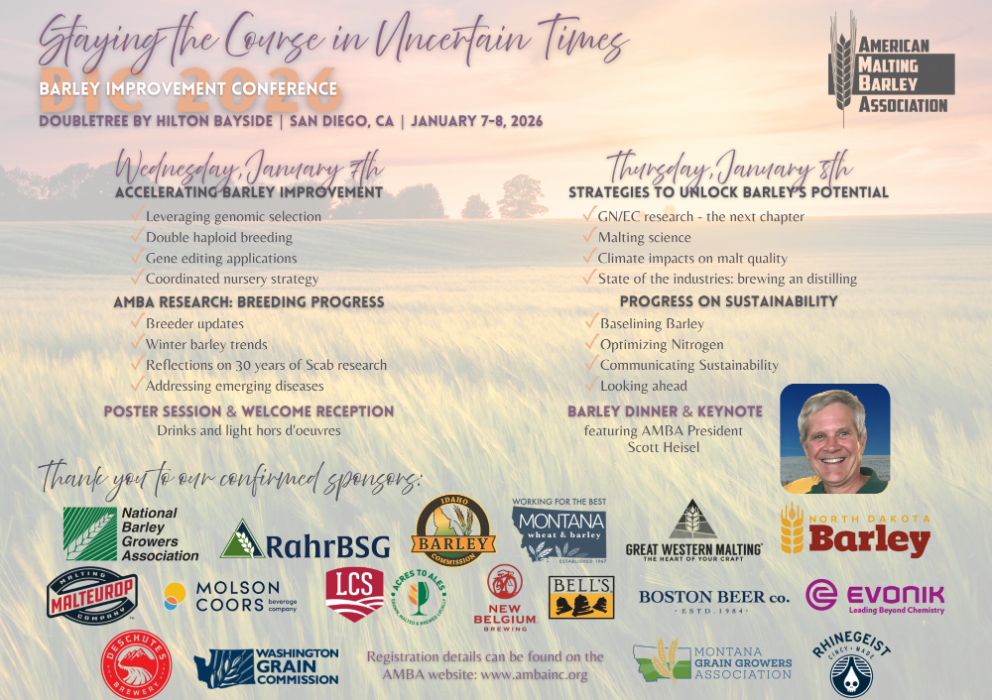
The Baselining Barley project partners are striving to have preliminary data to share during the joint meeting of AMBA and NBGA, which is scheduled for June 18th in Golden, CO.
.png)


.png)